Showing posts with label props. Show all posts

Monday, December 17, 2012

Interesting Drawing, Physical Fail

This is a drawing from early 2011 that I just dredged up while looking for something else (which I can't remember what it was now...)

I'm not entirely sure how this ended up a motorcycle, but I'm fairly certain I didn't intend it as one when I started, which led to a few things, the major ones being: 1: A visually interesting machine built to punch through walls, and 2: No steering.

That's Cameron, from the somewhat-in-progress-novel 'Clockwork Dog,' looking a bit older here than I think he'll be in the book when all's said and done. In this sketch he's just stolen it from someone richer than himself, because he's really got no reason to be riding such a contraption.


It'd be fun to do a redux of this, I think, since I like the idea of a beautiful battering-ram motorcycle, and it would be a good idea to solve the steering problem.

Friday, October 12, 2012

But...who builds all of this?

I got back from a revision retreat through the SCBWI last week. That's Society of Children's book Writers (and Illutrators). (Parenthesis are a personal observation ;) )

The first question out of anyone's mouth after either reading the story or looking at the illustrations from my BFA project is always So...how do animals make all this?

The short answer is: Griffins do.

It's one of those questions that hits at the sweet spot between fantasy, science, art, and writing that is World Building. So you've got an awesome concept: how does it work?

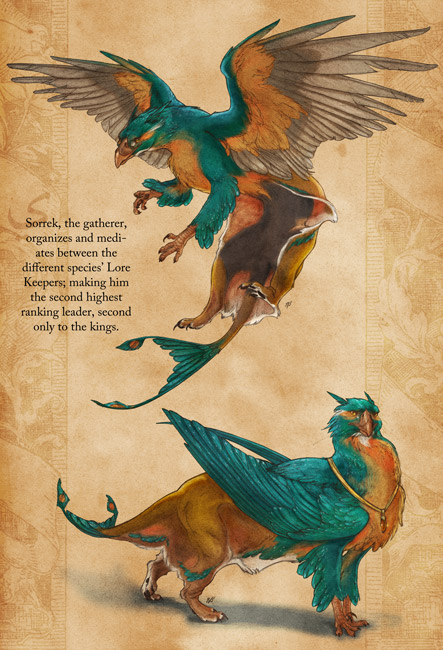
If you're a super geek, and want everything in your world to really work, you need more than the short answer. Sorrek here has the beginnings of my solution: I'd already branched out from the classical eagle-lion hybrid by making him more the size of a large lynx, and giving him the 'flying squirrel' flaps along his sides to help hold up that heavy cat part of him while flying. I'd decided years earlier that Dumarian griffins were smaller (about the size of a large lynx) and more omnivore than eagles or hawks. In keeping with the omnivore diet, I could swing the design toward less 'talon' and more 'finger' than your average eagle, and a semi-opposable hunting talon/thumb. But would this really work?

(Sorrek, 2010)

(Detail)

As time went on, I thought: would eagle hands really have that kind of dexterity? I wanted a solution that would be a little more unique to Dumaria, and to make them more of a cohesive creature instead of just a mashup. During a visit to the natural history museum in late 2011 with a good friend, I found something that perked my interest.

(Image from This Post)

Iguanodons had quasi-opposable pinkies! Of course, the artist in me really wanted to let my griffins keep their hunting talon, so they got both.

The new solution, doodled out.

Of course, now, the question was: how would having 2 thumbs work? Since I wasn't aware of any natural parallel to this new solution, I did what any sensible geek would do: I tried it out. For a whole week, I tried grabbing things as if my pinky went the other way. Uncomfortable at times, but under the excuse that their pinky would be built to do opposable digit things, unlike my human pinky (which is not built to do opposable-digit things) I could now confidently say that this hand model would work fairly similar to ours.

And let them build all manner of cool things for me to draw and write about.

Have you ever faced a similar challenge? I'd be interested to hear how you solved it! Feel free to post to relevant articles on similar issues in the comments.

Monday, July 30, 2012

Yucca Study

Another study, this time from Couer D'Alene. This is the first time I've sat down and really drawn a plant down to the leaf, instead of just generalizing or stylizing it. It was very instructive. The whiteout pen was a bit clunky, perhaps, but I like the look of it, anyway.
Done as more research for the Quickpaw project, which is still in script writing, but moving forward. Slowly but Surely. I've got another picture book to finish today, so after that's done...and a personal painting in the works...maybe the script will be ready to go to layout by then.

Wednesday, March 30, 2011

Dumarian Instruments


The finished Dumaria instruments! from top right, clockwise, are a 'howl dish,' a harp, a guiro/huiro, and some hanging chimes. This is what happens when you read too much Diontopia. Oh wait, there's no such thing as too much Dinotopia.

Wednesday, March 23, 2011

Woodcarving

Another ancient folk art: wood carving. It's pretty much what it sounds like, but there's a myriad of ways to carve wood, from chainsaw to chisel. Anything from large, rough hewn cuts to smooth polish can be achieved. A fun thing to work with on this image was trying to simulate how a wood gouge cuts with the grain, as well as some traditional patterns that have arisen from it, like the little notches along the tail and the mane. I also enjoyed simulating that high gloss finish, that sinks down into any ridges and catches the light. On real wood the finish can really sparkle and make the wood glow.

Chris Pye
An example of a carved box
Windsor Wood Carving Museum
Bas Relief wood carvings

Wednesday, March 16, 2011

Embroidery

Embroidery is one of the older decorative arts, and has been practiced for centuries from Europe to China. It involves creating a design using colored thread on cloth, often with other pieces of colored cloth sewn on. Lots of different designs are possibly using different stitches, or combination of them. Embroidery can be done by hand, or on a machine, or a combination of both.

This image mimics both machine and hand sewing techniques, but it's all digital.

The Bayeux Tapestry (Which is 20 inches tall and 231 feet long. Yes, feet.)
Chinese Embroidery
Azerbaijan embroidery
The Unicorn Tapestries at the Metropolitan Museum of Art

Friday, March 14, 2008

Lord Azural's Lair

My illustration professor has a particular knack for giving out assignments that instantly spark interest, quickly followed by the realization of their difficulty. It's a good combination. This specific ink and charcoal drawing was assigned as 'a villain's lair, in two point perspective.' It was a good excuse to blend Assyrian style with a little medieval , plus Azural's wolf motif. I turned it into somewhat of a study in props, also known as a messy room. This particular villain is also a personal novel character. Now I wonder from whom he inherited the tendency to have such a clutted desk?