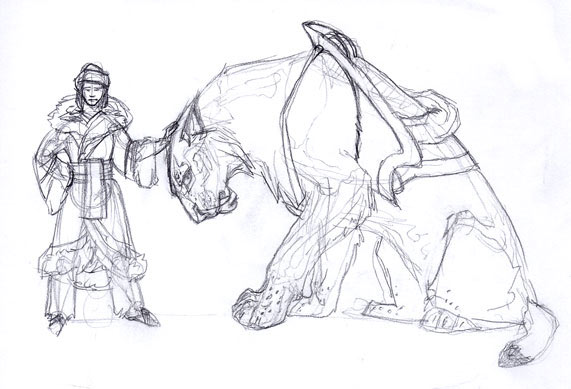
I got back from a revision retreat through the SCBWI last week. That's Society of Children's book Writers (and Illutrators). (Parenthesis are a personal observation ;) )
The first question out of anyone's mouth after either reading the story or looking at the illustrations from my BFA project is always So...how do animals make all this?
The short answer is: Griffins do.
It's one of those questions that hits at the sweet spot between fantasy, science, art, and writing that is World Building. So you've got an awesome concept: how does it work?
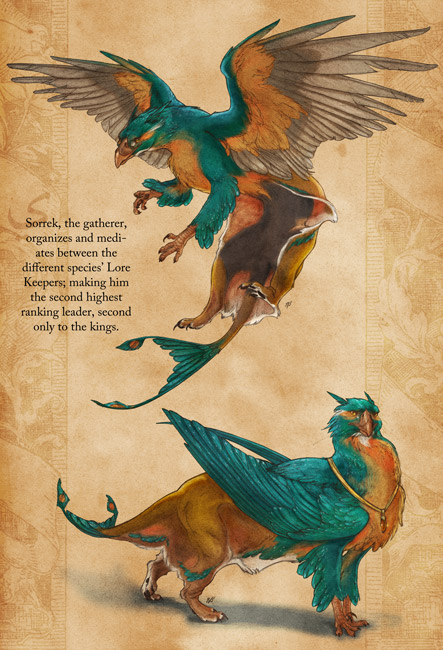
If you're a super geek, and want everything in your world to really work, you need more than the short answer. Sorrek here has the beginnings of my solution: I'd already branched out from the classical eagle-lion hybrid by making him more the size of a large lynx, and giving him the 'flying squirrel' flaps along his sides to help hold up that heavy cat part of him while flying. I'd decided years earlier that Dumarian griffins were smaller (about the size of a large lynx) and more omnivore than eagles or hawks. In keeping with the omnivore diet, I could swing the design toward less 'talon' and more 'finger' than your average eagle, and a semi-opposable hunting talon/thumb. But would this really work?
(Sorrek, 2010)
(Detail)
As time went on, I thought: would eagle hands really have that kind of dexterity? I wanted a solution that would be a little more unique to Dumaria, and to make them more of a cohesive creature instead of just a mashup. During a visit to the natural history museum in late 2011 with a good friend, I found something that perked my interest.
(Image from This Post)
Iguanodons had quasi-opposable pinkies! Of course, the artist in me really wanted to let my griffins keep their hunting talon, so they got both.
The new solution, doodled out.
Of course, now, the question was: how would having 2 thumbs work? Since I wasn't aware of any natural parallel to this new solution, I did what any sensible geek would do: I tried it out. For a whole week, I tried grabbing things as if my pinky went the other way. Uncomfortable at times, but under the excuse that their pinky would be built to do opposable digit things, unlike my human pinky (which is not built to do opposable-digit things) I could now confidently say that this hand model would work fairly similar to ours.
And let them build all manner of cool things for me to draw and write about.
Have you ever faced a similar challenge? I'd be interested to hear how you solved it! Feel free to post to relevant articles on similar issues in the comments.